Cross-Platform Mobile · React Native
Piko Social App
Production-grade cross-platform social application for iOS, Android, and web — built from inception with a single shared codebase, real-time messaging, and a 50+ component library.
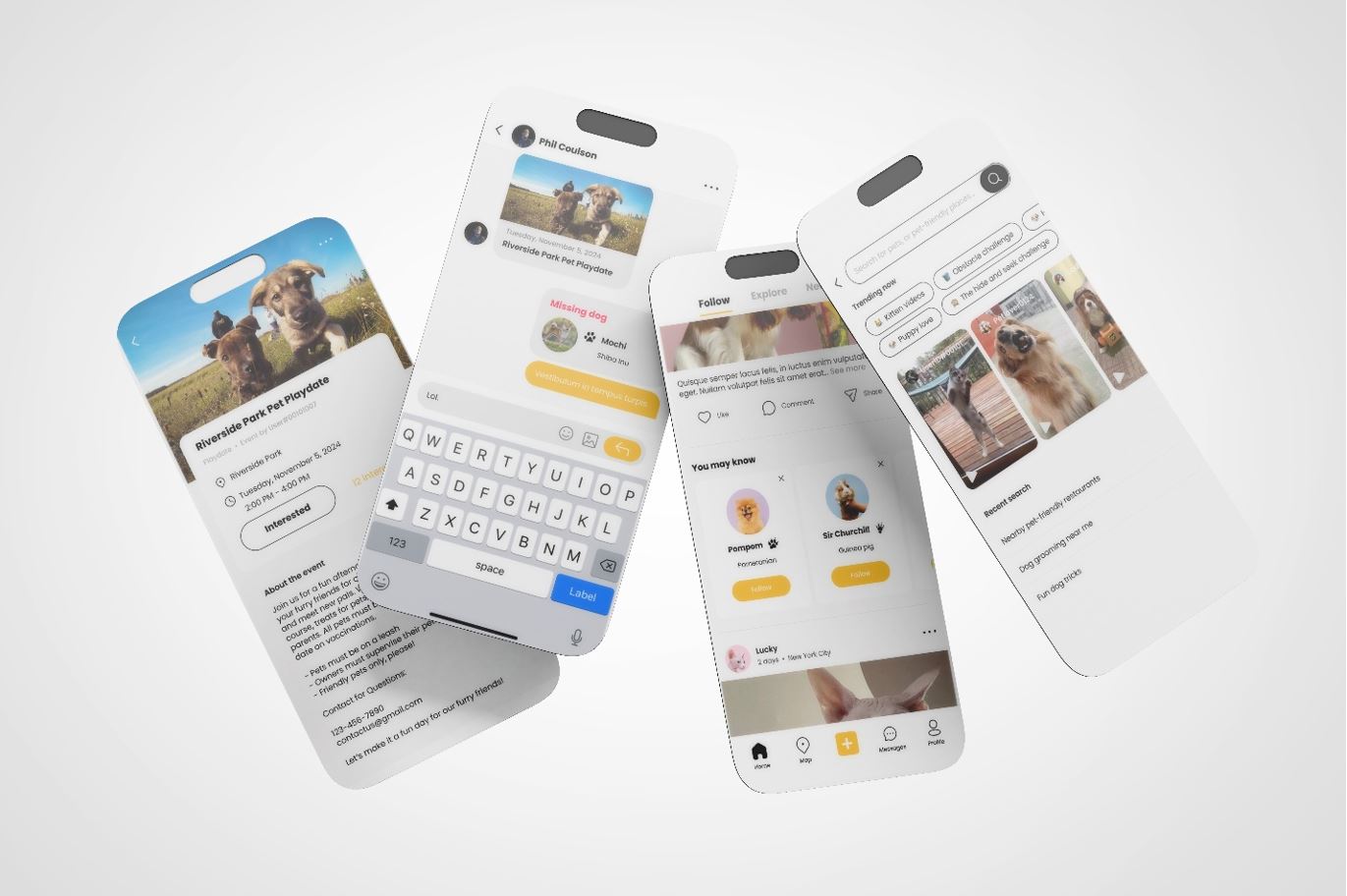
Production-ready cross-platform app — iOS, Android, and web from a single codebase
Project Overview
Built a production-ready cross-platform social application for pet owners from the ground up. The platform lets pet parents share moments, connect with other families, discover local events, and build community — with a consistent experience across iOS, Android, and web from a single React Native codebase.
Greenfield development from inception
Joined at day zero, contributing to critical architecture decisions and establishing the patterns that made rapid, scalable development possible. Built 50+ reusable components, implemented real-time features with GraphQL subscriptions, and resolved 40+ cross-platform compatibility issues to ship a polished, production-quality app.
The Challenge
PetoLab needed a comprehensive social platform built from scratch — capable of handling real-time social interactions, media-heavy content, and consistent UX across three platforms simultaneously. The architecture had to support future scaling to thousands of concurrent users without performance degradation.
Cross-platform consistency
Identical UX and visual consistency across iOS, Android, and web — with platform-specific optimisations where they matter.
Real-time features
GraphQL subscriptions for instant messaging, live notifications, and dynamic feed updates — without polling.
Media performance
Image and video uploads, compression, thumbnail generation, and adaptive playback across platforms with varying hardware.
Internationalisation
English and Chinese language support with proper pluralisation, locale-aware formatting, and instant runtime switching.
System Architecture
Layer 1 — Presentation
React Native + Expo 52
50+ reusable components, platform adapters (.native.tsx / .web.tsx), responsive layouts
Layer 2 — State management
Redux Toolkit
Feature slices, async thunks, memoised selectors, normalised relational state
Layer 3 — Data layer
GraphQL + REST (Apollo Client)
Queries, mutations, WebSocket subscriptions, media uploads
Layer 4 — Platform services
Expo Modules + Firebase
Camera, location, push notifications (FCM), Firebase Auth, Google/Apple sign-in
Layer 5 — Native platforms
iOS · Android · Web
Platform-specific optimisations isolated behind file-extension adapters
// Cross-platform request flow
Presentation (React Native / Web)
  → State (Redux Toolkit + async thunks)
  → API Layer (Apollo Client — queries / mutations / subscriptions)
  → Platform Services (Expo Modules / Firebase)
  → Native Platforms (iOS · Android · Web)
Key Technical Contributions
Comprehensive Component Library — 50+ Components
Cross-platform UI foundation that accelerated every feature built after it
Challenge: Build reusable components that behave identically on iOS, Android, and web while taking advantage of native performance where it matters — without duplicating logic.
Solution: Architected a library with platform file-extension adapters, a theming system, and responsive layouts from day one. Every component documented in Storybook.
Component categoriesCore primitives
- Avatar, Badge, Button, Icon, Image
- Text, Chip, Divider, Modal, BottomSheet
- LoadingIndicator, Carousel, Overlay
Input components
- TextInput, PasswordInput, SearchInput
- DatePicker, TimePicker, PickerInput
- ImageInput, VideoEditor, CameraModule
- LocationPicker, QRCodeScanner
Social components
- PostItem, CommentItem, MessageListItem
- UserProfileCard, PetProfileCard
- ActivityFeed, NotificationCard
- ChatMessage, GroupAvatar
Layout components
- ScreenLayout, PagerScreen, StackScreen
- ScrollList, VirtualizedList
- Header, TabBar, NavigationDrawer
// Image.web.tsx — web renderer
export const Image = ({ source, style, ...props }) =>
  <img src={source.uri} style={style} {...props} />;

// Image.native.tsx — iOS + Android (uses FastImage for caching)
import FastImage from '@d11/react-native-fast-image';
export const Image = ({ source, style, ...props }) =>
  <FastImage source={source} style={style} {...props} />;

// Shared usage — same import on every platform
import { Image } from '@/components/Image';Real-Time Social Features via GraphQL Subscriptions
Instant messaging, live notifications, and feed updates over WebSocket — zero polling
Challenge: Build a social platform where messages arrive instantly, notifications fire live, and feeds update without polling — matching what users expect from modern social apps.
Solution: Integrated Apollo Client's GraphQL subscriptions over WebSocket, with optimistic UI updates so interactions feel instant before server confirmation.
Instant messaging
- Direct 1-on-1 chat
- Group chat + typing indicators
- Read receipts and message status
- Image and video attachments
Live notifications
- Push via Firebase Cloud Messaging
- In-app notification centre
- Friend requests and invitations
- Activity feed with live updates
Feed updates
- New post subscriptions
- Live comment and like counters
- Event RSVP updates
- Optimistic UI for all mutations
export const useChatSubscription = (chatId: string) => {
  return useSubscription(NEW_MESSAGE_SUBSCRIPTION, {
    variables: { chatId },
    onData: ({ client, data }) => {
      // Write directly into Apollo cache — no refetch needed
      client.cache.modify({
        id: client.cache.identify({ __typename: 'Chat', id: chatId }),
        fields: {
          messages: (existing) => [data.data.messageAdded, ...existing],
        },
      });
    },
  });
};Redux Architecture for Complex State Management
Feature slices, async thunks, normalised state, and optimistic updates
Challenge: Managing user sessions, content feeds, chat history, real-time updates, and UI state across 20+ screens — without performance degradation or race conditions.
Solution: Feature-based Redux Toolkit architecture with normalised state, memoised selectors, and async thunks keeping all business logic out of components.
State slices
authSlice— sessions and tokenspostSlice— feed and post managementchatSlice— messaging and conversationspetProfileSlice— pets and relationshipseventSlice— events and attendancenotificationSlice— activities and alerts
Architecture patterns
- Feature-based slice organisation
- Memoised selectors (Reselect)
- Async thunks for all API calls
- Normalised state for relational data
- Optimistic updates for likes and follows
- AsyncStorage for offline persistence
const postSlice = createSlice({
  name: 'post',
  initialState: { feed: [], loading: false, hasMore: true },
  reducers: {
    // Flip like instantly — server confirms (or reverts) asynchronously
    optimisticToggleLike: (state, { payload: postId }) => {
      const post = state.feed.find(p => p.id === postId);
      if (post) post.isLiked = !post.isLiked;
    },
  },
  extraReducers: builder => {
    builder
      .addCase(fetchPostFeed.pending, s => { s.loading = true; })
      .addCase(fetchPostFeed.fulfilled, (s, { payload }) => {
        s.feed = [...s.feed, ...payload.posts];
        s.hasMore = payload.hasMore;
        s.loading = false;
      });
  },
});Multilingual Support with LinguiJS
English + Chinese, 1,000+ strings, zero runtime parsing overhead
Challenge: Support English and Mandarin Chinese with proper pluralisation, locale-aware formatting, and instant runtime language switching — without a performance hit from runtime string parsing.
Solution: LinguiJS 5 with automated message extraction, compiled PO catalogs (no parsing at runtime), and TypeScript integration for compile-time validation of missing keys.
Automated extraction from source, PO file management, compiled catalogs — zero parsing overhead at runtime.
Pluralisation rules, number/date/currency formatting, time zone awareness, RTL layout preparation.
TypeScript autocomplete, compile-time validation, hot reload support, Storybook locale switcher.
import { Trans, t } from '@lingui/macro';
import { useLingui } from '@lingui/react';

export const NotificationBanner = ({ count }: { count: number }) => {
  const { i18n } = useLingui();
  return (
    <View>
      <Text><Trans>Welcome to PetoKingdom!</Trans></Text>
      <Text>
        {i18n._(t`You have ${count} new ${count === 1 ? 'notification' : 'notifications'}`)}
      </Text>
    </View>
  );
};

// zh.po catalog
// msgid "Welcome to PetoKingdom!"
// msgstr "欢迎来到宠物王国!"Cross-Platform Compatibility — 40+ Issues Resolved
Systematic debugging across iOS, Android, and web to ship production-quality UX
Challenge: Cross-platform development surfaces subtle but user-facing bugs — styling inconsistencies, keyboard handling, native module incompatibilities — that only appear on specific platforms.
Solution: Established a platform-testing discipline running every feature on a physical iOS device, Android emulator, and web before closing a ticket. Issues tracked and categorised by root cause.
Styling inconsistencies
- Flexbox behaviour differences
- Font rendering and line-height gaps
- Shadow and elevation on Android
- Border radius clipping issues
Responsive design
- Keyboard avoidance and layout shift
- Safe area insets (notch, home bar)
- Tablet and foldable adaptation
- Orientation change reflow
Native module issues
- Camera permission flows per platform
- Video playback performance (Android)
- File system access differences
- Deep linking and URL schemes
Performance fixes
- List virtualisation for large feeds
- FastImage LRU caching
- Subscription memory leak prevention
- Bundle size reduction via tree shaking
Advanced Media Handling & Optimisation
Image and video pipelines from capture to CDN — 60–80% video size reduction
Challenge: A social app lives and dies by media quality and speed. Image and video uploads needed compression, thumbnail generation, HEIC conversion, and cross-platform playback without blocking the UI.
Solution: Built separate image and video pipelines using Expo Image Picker, Vision Camera 4, and FFmpegKit — with background upload, progress tracking, and adaptive quality by connection speed.
Capture, gallery pick, crop, HEIC→JPEG, 70% quality compression, thumbnail generation, chunked CDN upload.
Recording with time limits, trim editor, FFmpeg H.264 compression, poster frame extraction, background upload.
FastImage LRU cache, progressive JPEG, WebP on Android, lazy loading in virtualised lists, CDN integration.
import { FFmpegKit, ReturnCode } from 'ffmpeg-kit-react-native';

const compressVideo = async (inputPath: string): Promise<string> => {
  const output = `${FileSystem.cacheDirectory}v_${Date.now()}.mp4`;

  // H.264 · CRF 28 · fast preset · AAC audio · web-optimised moov atom
  const cmd = `-i ${inputPath} -c:v libx264 -crf 28 -preset fast ` +
              `-c:a aac -b:a 128k -movflags +faststart ${output}`;

  const session = await FFmpegKit.execute(cmd);
  if (ReturnCode.isSuccess(await session.getReturnCode())) return output;
  throw new Error(await session.getOutput());
  // Typical result: 60–80% smaller file, imperceptible quality loss
};Core Application Features
Social networking
- User profiles and pet profiles
- Friend connections and family crews
- Content feed with posts and media
- Comments, likes, and shares
- Hashtag discovery
- QR code pet profile sharing
Messaging
- Direct 1-on-1 chat
- Group chat with multiple users
- Real-time message delivery
- Media sharing (images and videos)
- Read receipts and typing indicators
Events and activities
- Create and discover local pet events
- Map-based event discovery
- RSVP and attendance tracking
- Event notifications and reminders
- Lost pet alerts
Content creation
- Photo and video capture and upload
- AI-powered breed detection
- Content editing and filters
- Draft management
- Multilingual caption support
Complete Technology Stack
Core framework
State & data
UI & animation
Navigation
Media
Platform services
Internationalisation
Testing & tooling
Results & Business Impact
Engineering Learnings
Architecture decisions compound early
Building from inception taught that choosing cross-platform development and a modular component architecture at day zero either accelerates or constrains every week that follows. Upfront investment pays multiplicatively.
Performance must be designed in, not added later
Virtualisation, lazy loading, and image caching are orders of magnitude harder to retrofit. Building them in from the start meant the app stayed smooth even as the feature set grew to 20+ screens.
Component libraries pay forward
Every hour invested in the component library in month one saved two hours in every month after. The 40% acceleration wasn't a one-time gain — it compounded with every feature shipped.
Test on all platforms, every time
Cross-platform development looks identical in code and catastrophic in practice. The 40+ resolved bugs were almost all invisible on the development platform and immediately visible on the other two.
State architecture shapes the product
Redux Toolkit's slice pattern and async thunks kept business logic outside components. Without normalised state, the relational data (users, pets, posts, chats) would have become a maintenance burden at scale.
Real-time requires careful teardown
GraphQL subscriptions with optimistic updates created the responsiveness users expect — but reliability came from treating reconnection, error states, and subscription cleanup as first-class concerns, not edge cases.